
Category: buying
Peptide Certificate of Analysis: How to Read One Before You Buy
Posted on July 22, 2026
Introduction
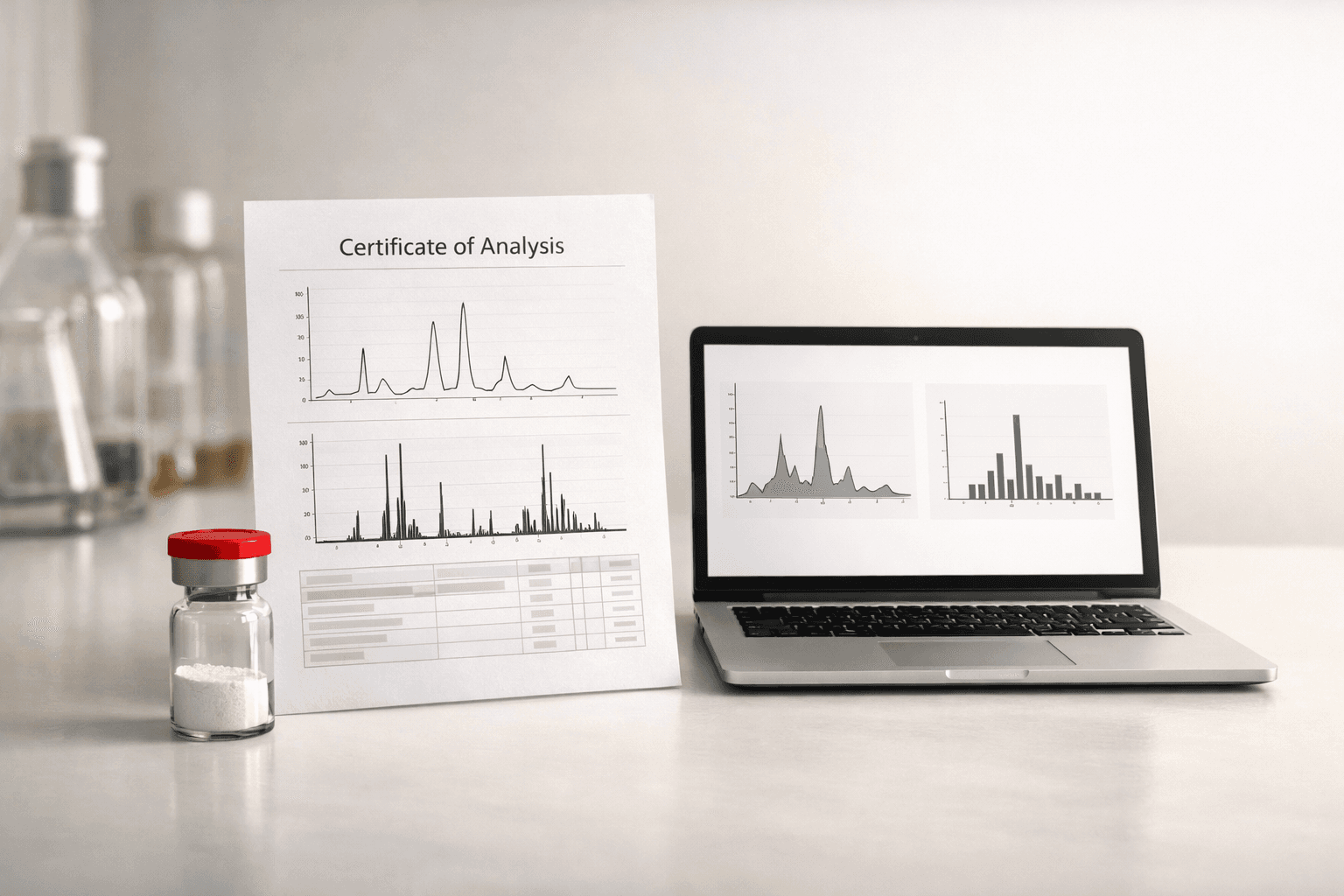
A peptide certificate of analysis can look reassuring at first glance. There is usually a batch number, a purity percentage, maybe a chromatogram, and a few technical details that seem official enough. But for buyers in the research peptide market, the real question is not whether a COA exists. It is whether the document actually helps you judge identity, purity, and batch credibility.
That distinction matters. Two suppliers can both claim research-grade peptides, yet one may provide batch-specific HPLC and mass spectrometry data while the other offers a recycled PDF with vague numbers and no clear link to the vial in your hand. On a busy ordering day, especially when comparing products across multiple Canadian peptide suppliers, that difference is easy to miss.
So let’s slow it down. A good COA is not a decoration. It is part of the buying decision, right alongside product selection, storage expectations, supplier transparency, and overall value. If you know what to look for, the document becomes a useful filter instead of just another file in the checkout process.
What a Peptide Certificate of Analysis Actually Tells You
A peptide certificate of analysis is a batch document that summarizes analytical testing performed on a peptide lot. In practical terms, it should help confirm that the material being sold matches the stated peptide identity and meets the supplier’s stated purity specification.
For research buyers, the most useful COAs usually include:
- Peptide name or sequence reference
- Batch or lot number
- Purity percentage, commonly by HPLC
- Molecular weight or mass confirmation, commonly by mass spectrometry
- Test date or report date
- Lab or testing party information
- Appearance or physical form, often lyophilized powder
- Any stated storage conditions
That list sounds simple, but the details do the heavy lifting. A COA that says 99% purity without showing how that number was generated is less useful than one with a chromatogram, a mass spectrum, and a batch identifier that matches the product label.
Think of it like buying lab equipment secondhand. A seller saying barely used is one thing. Seeing calibration records, serial numbers, and service history is another. Peptides deserve the same kind of scrutiny.
Why HPLC Purity Matters on a Peptide Certificate of Analysis
High-performance liquid chromatography, or HPLC, is one of the standard tools used to assess peptide purity. It separates compounds in a sample based on their interactions with the column and solvent system. The output is usually a chromatogram with peaks.
For a peptide buyer, the main peak represents the target peptide under the test conditions. Smaller peaks may represent related impurities, truncated sequences, deletion products, residual synthesis byproducts, or degradation products. The purity percentage is generally calculated from the area of the target peak compared with the total detected peak area.
This is why the chromatogram matters. A single purity number can hide context.
What to look for in HPLC data
- A clear main peak with a retention time
- A stated purity percentage
- A chromatogram that appears batch-specific
- Reasonable integration of peaks
- A report that names the peptide or lot being tested
The number itself is not the whole story. A peptide listed at 98% by HPLC may be a better purchase than a supposedly higher-purity product if the first supplier provides transparent testing and the second provides only a generic claim.
There is also a buyer psychology piece here. Many people shop by the highest purity number because it feels objective. Fair enough. But experienced research buyers tend to ask a sharper question: can the supplier show how that number was obtained?
Mass Spectrometry Confirms Identity, Not Just Cleanliness
HPLC helps evaluate purity. Mass spectrometry helps confirm identity. They are related, but they are not the same test.
Mass spec measures the molecular mass of a compound and compares the detected value with the expected mass of the target peptide. If the observed mass lines up with the expected molecular weight, that supports the identity of the peptide in the sample.
This is especially important in peptide synthesis because a material can appear relatively clean by HPLC while still not being the intended sequence. Peptides are built amino acid by amino acid, and errors during synthesis or cleavage can produce closely related materials. Mass spec provides another layer of confirmation.
A strong peptide certificate of analysis will often include both HPLC and mass spectrometry because each test answers a different question:
- HPLC asks: how much of the detected material appears to be the target compound under this method?
- Mass spec asks: does the detected compound match the expected molecular mass?
Neither test is magic. Analytical results depend on method quality, sample preparation, and reporting standards. Still, when both are present and batch-specific, the buyer has much more to work with.
Batch Numbers: The Detail Buyers Should Not Skip
Batch numbers are not glamorous. They do not get the attention that purity percentages do. But they are one of the easiest ways to separate a useful COA from a weak one.
A batch-specific COA should connect directly to the product lot being sold. The batch number on the document should match the batch identifier on the vial, product packaging, or supplier record. If a supplier cannot show that connection, the COA loses much of its practical value.
Here is a realistic scenario. You are comparing two vials of the same peptide from different suppliers. Both claim high purity. One has a COA with a lot number, testing date, HPLC trace, and mass spec result. The other has a clean-looking PDF, but no batch number and no test date. The second document may still look professional, yet it gives you very little accountability.
Batch consistency also matters when research work depends on comparable materials over time. If a lab changes suppliers or receives different lots, variations in purity, counterion content, residual moisture, or handling can affect experimental consistency. A transparent batch record does not remove every variable, but it makes those variables easier to track.
Red Flags When Reviewing a Peptide COA
Not every COA should be treated as equal. Some are helpful. Some are incomplete. Some are little more than marketing collateral dressed up as technical documentation.
A few warning signs deserve attention:
- No batch or lot number
- No HPLC chromatogram or mass spec data
- Purity stated without method details
- Same document reused across multiple products
- Blurry screenshots or cropped reports
- No date or outdated testing information
- Mismatch between peptide name, label, and COA
- Claims that go far beyond research-use context
One red flag does not always mean a product is unusable for research, but it should prompt more questions. Good suppliers expect informed buyers to ask for clarity. Weak suppliers often rely on buyers not asking.
The language around the COA can also be revealing. If the sales page leans heavily on dramatic claims but gives little analytical detail, that is not a great sign. Research peptides should be presented with technical restraint, not miracle language.
How a Peptide Certificate of Analysis Fits Into the Buying Decision
A COA is only one part of supplier evaluation. It sits inside a wider decision that includes product handling, catalogue clarity, ordering experience, and overall value.
For Canadian buyers, the practical comparison often looks like this:
- Does the supplier provide clear product names and formats?
- Are peptides presented as research-use materials?
- Is testing information available and batch-relevant?
- Is pricing easy to understand without relying on exaggerated claims?
- Does the supplier communicate storage expectations clearly?
- Are product pages organized enough to compare options quickly?
Value is not simply the lowest listed price. In peptide sourcing, value is closer to cost per credible milligram, adjusted for transparency, testing, and confidence in batch identity. A cheaper vial with vague documentation may not be cheaper if it creates uncertainty in the research workflow.
This is where product browsing should feel orderly. A buyer reviewing the Peptides category should be able to compare research materials without decoding messy labels or chasing basic information. Product pages such as Wolverine, Retatrutide, and Tesamorelin should make it clear what material is being considered, while the supporting quality documentation helps answer the next layer of questions.
Reading Between the Lines: Purity, Stability, and Handling
Purity at the time of testing does not guarantee that a peptide will remain unchanged forever. Peptides can be sensitive to moisture, temperature, repeated freeze-thaw cycles, light exposure, oxidation, or pH depending on the sequence and format.
Most research peptides are supplied as lyophilized powder because freeze-drying improves stability compared with peptides already in solution. Once reconstituted in a lab setting, stability can change significantly. That is why storage guidance, careful lab hygiene, and minimizing unnecessary handling all matter.
A COA will not tell you everything about future stability. It is more like a snapshot of the tested batch under the conditions of analysis. Still, it gives a baseline. If the peptide starts from a cleaner, verified batch, researchers have fewer unknowns before they even begin their work.
For lab teams, this is also where documentation habits pay off. Recording lot numbers, reconstitution dates, solvent used, storage conditions, and observed changes can help distinguish material issues from workflow issues. Small details become useful later, usually when someone is trying to figure out why a result did not behave as expected.
Third-Party Testing Versus In-House Testing
Third-party testing is often preferred because it adds distance between the seller and the analytical result. An independent lab has less incentive to shape the outcome around a sales claim. That said, buyers should still look at the quality of the report itself, not just the phrase third-party tested.
In-house testing can also be useful when performed properly and reported transparently. The key is not the label alone. The key is whether the data are clear, batch-specific, and technically meaningful.
A practical way to think about it:
- Third-party testing can increase trust when documentation is complete
- In-house testing can be informative when methods and batch data are transparent
- Unsupported purity claims are weak regardless of who makes them
The strongest suppliers tend to understand that informed buyers want evidence, not just adjectives. Clean, clear documentation saves everyone time.
The Canadian Buyer’s Perspective
The Canadian research peptide market has become more sophisticated. Buyers are not just searching for product names anymore. They are searching for terms like HPLC purity, peptide COA, mass spec verification, lyophilized peptide storage, and research peptide supplier Canada. That shift says a lot.
It suggests buyers are comparing suppliers less like casual shoppers and more like procurement-minded researchers. They want to know whether a peptide is identified, whether the batch is documented, and whether the supplier is operating with enough transparency to earn repeat business.
There is also a local context. Canadian buyers often prefer suppliers that understand the research-use framing, present product information clearly, and avoid overpromising. The industry has enough noise already. A measured, documentation-first approach stands out.
Why Choose Nu-Forme Labs
Nu-Forme Labs is built for buyers who care about more than a product name on a vial. The goal is to make peptide sourcing feel clearer, more deliberate, and easier to evaluate before a purchase is made.
That starts with a focused Peptides category and product pages that are designed for comparison. Whether a buyer is reviewing Wolverine, Retatrutide, Tesamorelin, or another research peptide, the decision should be supported by clear naming, organized product information, and a research-use approach that respects the technical nature of the category.
Nu-Forme Labs also recognizes that value is not only about the lowest visible price. For research buyers, value comes from confidence: knowing what is being ordered, understanding how quality is represented, and being able to compare options without wading through exaggerated claims.
If you are evaluating peptide suppliers, look for the quiet signals. Transparent documentation. Consistent terminology. Sensible product organization. No dramatic promises. Those details may not be flashy, but in this market they matter.
Final Thoughts
A peptide certificate of analysis is not just paperwork. It is one of the clearest windows into how a supplier thinks about quality, accountability, and the buyer’s need for confidence.
The best COAs help answer three basic questions: is the peptide likely to be what the label says, how pure was it under the stated test method, and can the result be tied to a specific batch? If the document cannot help with those questions, it is worth asking why.
For researchers and informed buyers, the smartest purchasing decisions usually come from combining technical review with practical supplier judgment. Read the COA. Check the batch details. Compare the product page. Consider the value behind the price. It takes a few extra minutes, but those minutes can prevent a lot of uncertainty later.
Frequently asked questions
- Should I trust a peptide supplier that only lists a purity percentage?
- A purity percentage is a starting point, not the whole story. Buyers should look for supporting HPLC data, mass spectrometry confirmation, and a batch number that ties the result to the product being sold.
- Is a higher purity number always the better buy?
- Not automatically. A slightly lower stated purity with clear batch-specific documentation may be more useful than a higher claim with no chromatogram, no mass spec data, or no lot traceability.
- What should Canadian buyers compare besides the COA?
- Compare product clarity, research-use framing, storage information, catalogue organization, and overall value. A credible supplier should make it easy to understand what you are ordering without leaning on exaggerated claims.
- Does mass spectrometry replace HPLC testing?
- No. Mass spectrometry supports identity confirmation, while HPLC is commonly used to assess purity. Together, they provide a stronger picture than either test alone.