
Category: Metabolic & Body Composition
Retatrutide vs Tirzepatide: Comparing the Latest Clinical Evidence
Posted on July 29, 2026
Introduction
Retatrutide vs tirzepatide is an easy comparison to make in conversation and a harder one to make responsibly from the literature. Both sit in the incretin-adjacent metabolic research world. Both have been studied in adults with obesity or type 2 diabetes. Both are given once weekly by subcutaneous injection in clinical trials.
But the evidence is not symmetrical. Tirzepatide has multiple large phase 3 trials and regulatory approvals as a prescription drug in some jurisdictions. Retatrutide has phase 2 human data, including obesity and type 2 diabetes trials, but it remains investigational. That difference matters before anyone starts comparing headline percentages.
For readers tracking midlife metabolic change, especially women in their 30s to 60s, the useful question is not which compound wins. The better question is what the studies actually measured, who was enrolled, and whether the results tell us anything specific about women approaching or past menopause. Often, they do not.
What the retatrutide vs tirzepatide research set out to answer
The retatrutide trials asked early clinical-development questions: what dose ranges look active, how much body weight or HbA1c changes over several months, and what tolerability signals appear when a triple receptor agonist is tested in humans.
Retatrutide activates GLP-1, GIP, and glucagon receptors. That receptor profile is the reason it attracts attention, but receptor biology is not the same thing as a clinical outcome. The human trials still have to show what changes in measured endpoints such as body weight, HbA1c, waist circumference, liver fat, blood pressure, adverse events, and discontinuation rates.
The tirzepatide studies are further along. SURMOUNT-1 and SURMOUNT-3 studied adults with obesity or overweight without diabetes, while SURPASS-2 studied adults with type 2 diabetes against semaglutide 1 mg. These were larger trials designed to test efficacy and safety in populations closer to regulatory decision-making.
That sets up the central caution: retatrutide and tirzepatide can be compared as bodies of evidence, but their numbers should not be treated as if they came from the same trial.
What the retatrutide clinical studies did
In the phase 2 obesity trial published in the New England Journal of Medicine, researchers randomized 338 adults with obesity, or overweight with at least one weight-related condition, to placebo or once-weekly subcutaneous retatrutide. Doses ranged from 1 mg to 12 mg, with some groups using dose escalation. The trial ran for 48 weeks, and the primary endpoint was percent change in body weight at 24 weeks.
That endpoint matters. A 24-week body-weight endpoint captures scale change during active treatment; it does not capture long-term maintenance, body-composition quality, or what happens after stopping the study drug.
A separate phase 2 trial in adults with type 2 diabetes randomized 281 participants to retatrutide, placebo, or dulaglutide 1.5 mg. The primary endpoint was change in HbA1c at 24 weeks. Body weight was an important secondary measure, but the study was built around glycemic control.
So, for retatrutide, the strongest human evidence so far is phase 2 dose-finding research. Useful? Yes. Definitive? Not yet.
What the tirzepatide clinical studies did
SURMOUNT-1 enrolled 2,539 adults with obesity or overweight without diabetes. Participants received once-weekly subcutaneous tirzepatide at 5 mg, 10 mg, or 15 mg, or placebo, for 72 weeks. The co-primary endpoints were percent change in body weight and the proportion of participants losing at least 5% of baseline weight.
SURMOUNT-3 had a more specific design. Adults first completed a 12-week intensive lifestyle run-in. Those who lost at least 5% of body weight were then randomized to tirzepatide or placebo for 72 weeks. This design asked a different question: after an initial lifestyle-led reduction, what happened with continued randomized treatment?
SURPASS-2 compared tirzepatide with semaglutide 1 mg in 1,879 adults with type 2 diabetes over 40 weeks. The primary endpoint was HbA1c change from baseline. Weight change was secondary, and the comparator was active rather than placebo.
These design differences are not trivia. They shape the answer.
What they found in body-weight endpoints
In the phase 2 human RCT of retatrutide for obesity, mean body-weight change at 24 weeks ranged from about 7.2% at 1 mg to 17.5% at 12 mg, compared with 1.6% with placebo. At 48 weeks, the higher-dose retatrutide groups showed larger mean reductions, including about 22.8% with 8 mg and 24.2% with 12 mg, compared with 2.1% for placebo.
Those are notable phase 2 findings. They are also from 338 participants, not a large phase 3 outcomes program.
In SURMOUNT-1, a phase 3 human RCT, tirzepatide produced mean body-weight changes at 72 weeks of 15.0%, 19.5%, and 20.9% for 5 mg, 10 mg, and 15 mg, respectively, compared with 3.1% for placebo. The trial was much larger than the retatrutide obesity study and ran longer.
SURMOUNT-3 found that, after an initial lifestyle run-in, participants randomized to tirzepatide had an additional mean weight change of 18.4% from randomization to week 72, while placebo participants regained 2.5% on average. Again, this was a phase 3 human RCT, but the population had already responded to the run-in phase, so it should not be read as identical to SURMOUNT-1.
Here is the cleanest way to read the comparison: retatrutide has generated large weight-change signals in phase 2; tirzepatide has demonstrated large weight-change effects across multiple phase 3 trials. The evidence maturity is different.
What they found in glycemic and metabolic endpoints
In the retatrutide type 2 diabetes phase 2 RCT, the primary endpoint was HbA1c change at 24 weeks. Retatrutide lowered HbA1c more than placebo and produced dose-related body-weight reductions. The trial also included dulaglutide as an active comparator, which helps anchor the findings against an established incretin drug rather than placebo alone.
In SURPASS-2, a phase 3 human RCT, tirzepatide was compared directly with semaglutide 1 mg in adults with type 2 diabetes. HbA1c reductions were greater with tirzepatide 5 mg, 10 mg, and 15 mg than with semaglutide 1 mg at 40 weeks. Body-weight reductions were also greater in the tirzepatide groups than in the semaglutide group.
This is one place where tirzepatide has the stronger comparative evidence. SURPASS-2 was not a retatrutide trial, of course, but it was an active-comparator phase 3 trial. Retatrutide does not yet have the same depth of phase 3 comparator data in published literature.
For a reader scanning metabolic research during midlife, it is tempting to focus on scale movement. The studies, however, also measured HbA1c, fasting glucose, lipids, waist circumference, blood pressure, and adverse events. Those endpoints can matter just as much, depending on the research question.
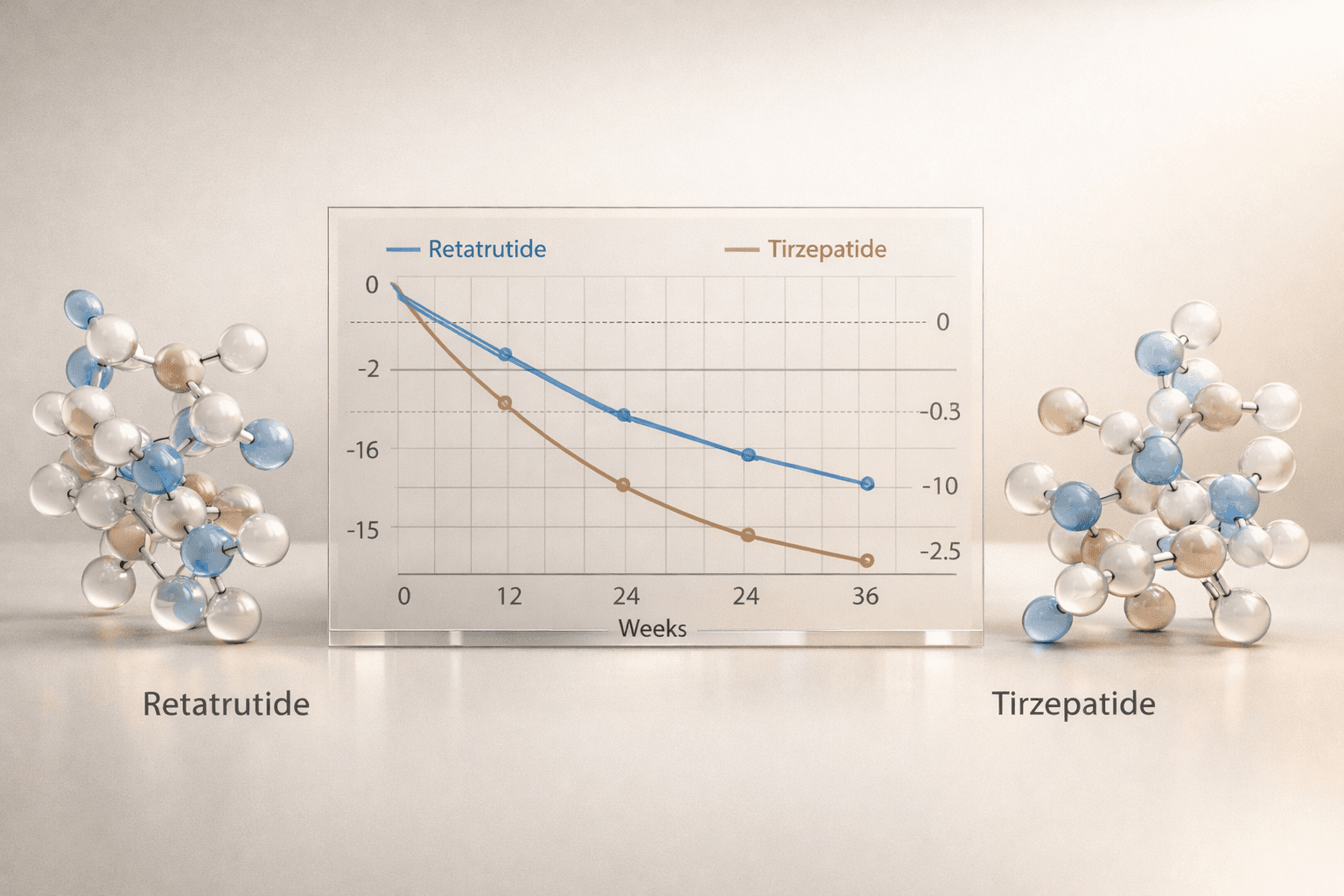
Retatrutide vs tirzepatide clinical evidence is not a direct race
Cross-trial comparisons are seductive and often misleading. Different inclusion criteria, baseline body weight, diabetes status, background medications, titration schedules, adherence patterns, and dropout rules can all shift the numbers.
The retatrutide obesity trial was phase 2 and ran 48 weeks. SURMOUNT-1 was phase 3 and ran 72 weeks. SURMOUNT-3 selected people who had already lost weight during a lifestyle run-in. SURPASS-2 enrolled people with type 2 diabetes and used semaglutide as the comparator.
So if someone asks whether retatrutide produced a larger percentage change in one trial than tirzepatide did in another, the honest answer is: maybe on paper, but that is not the same as a head-to-head result.
A proper head-to-head trial would randomize similar participants to retatrutide or tirzepatide under the same protocol, with the same dose-escalation rules, endpoints, and follow-up period. That published trial is not available as of this writing.
What this tells us about women specifically
This is where the evidence gets thinner than many readers would like.
The retatrutide obesity trial enrolled both women and men, with women making up a little over half of participants. The type 2 diabetes retatrutide trial also enrolled both sexes, but menopausal status was not reported in the main publication. Results were not presented in a way that lets a reader clearly separate premenopausal, perimenopausal, postmenopausal, or postpartum participants.
Tirzepatide trials enrolled large numbers of women. SURMOUNT-1 was about two-thirds female, and SURMOUNT-3 was also majority female. That is helpful, because women were not a token subgroup. But the publications did not make menopause a central analytic category. They did not answer whether responses differed in perimenopause versus postmenopause, or whether vasomotor symptoms, sleep disruption, hormone therapy status, parity, or postpartum timing changed the observed outcomes.
For a woman in her late 40s wondering whether trial averages apply to her current body, that gap matters. Midlife metabolic change often intersects with sleep, muscle mass, thyroid evaluation, medications, training history, and changing sex-hormone patterns. The trials measured important metabolic endpoints, but they were not built around the lived physiology of perimenopause or menopause.
The trial did not say is not a weak answer here. It is the accurate one.
What this doesn't tell us
The biggest limitation is that retatrutide and tirzepatide have not been compared head-to-head in a published randomized trial. Any numeric comparison across separate studies is indirect.
The second limitation is maturity of evidence. Tirzepatide has larger phase 3 programs, longer published follow-up in obesity trials, and active-comparator data in type 2 diabetes. Retatrutide has promising phase 2 findings, but phase 2 trials are designed to explore dose, signal, and tolerability before larger confirmation.
The third limitation is body composition. Weight change is not the same as fat-mass change, lean-mass preservation, strength, resting energy expenditure, or physical function. Some incretin trials include body-composition substudies, but the core publications discussed here are not enough to answer the full lean-mass question for midlife women.
Adverse events also need a sober read. Gastrointestinal adverse events were common across these incretin-based trials, and discontinuations occurred. Retatrutide research has also drawn attention to heart-rate changes, which require ongoing study. These findings are part of the evidence, not footnotes.
Finally, regulatory status is different. Tirzepatide is an approved prescription medicine for specific indications in jurisdictions including the United States and Canada. Retatrutide is investigational and is not approved by the FDA or Health Canada as of July 29, 2026. Research-use supply is not drug approval, and compounding-list status is not drug approval either.
For basics on peptide terminology, readers can use the Nu-Forme Labs Peptide Glossary. For documentation standards, the Certificate of Analysis guide is the better place to start than any marketing claim. The Retatrutide research page can be read with the same evidence-first lens used here.
Sources
-
Jastreboff AM, Kaplan LM, Frias JP, et al. Triple-Hormone-Receptor Agonist Retatrutide for Obesity: A Phase 2 Trial. New England Journal of Medicine. 2023. Study type: human RCT. n=338. DOI: 10.1056/NEJMoa2301972.
-
Rosenstock J, Frias JP, Jastreboff AM, et al. Retatrutide for Type 2 Diabetes: A Randomised, Double-Blind, Placebo and Active-Controlled, Parallel-Group, Phase 2 Trial. The Lancet. 2023. Study type: human RCT. n=281. DOI: 10.1016/S0140-6736(23)01053-X.
-
Jastreboff AM, Aronne LJ, Ahmad NN, et al. Tirzepatide Once Weekly for the Treatment of Obesity. New England Journal of Medicine. 2022. Study type: human RCT. n=2,539. DOI: 10.1056/NEJMoa2206038.
-
Wadden TA, Chao AM, Machineni S, et al. Tirzepatide After Intensive Lifestyle Intervention in Adults With Overweight or Obesity: The SURMOUNT-3 Phase 3 Trial. Nature Medicine. 2023. Study type: human RCT. n=579 randomized. DOI: 10.1038/s41591-023-02597-w.
-
Frias JP, Davies MJ, Rosenstock J, et al. Tirzepatide Versus Semaglutide Once Weekly in Patients With Type 2 Diabetes. New England Journal of Medicine. 2021. Study type: human RCT. n=1,879. DOI: 10.1056/NEJMoa2107519.
Working With Nu-Forme Labs
Nu-Forme Labs approaches research compounds from the documentation side first: identity, purity, testing transparency, and Canadian supply practices. That does not turn investigational compounds into approved medicines, and it does not replace clinical evidence.
For researchers evaluating peptides, the useful starting point is still the paper trail: published studies, current regulatory status, and batch-specific analytical documentation.
Final Thoughts
Retatrutide vs tirzepatide is not a simple scoreboard. Retatrutide has produced strong phase 2 signals in human metabolic trials. Tirzepatide has a deeper phase 3 evidence base, including large obesity trials and an active-comparator diabetes trial.
The most responsible read is also the most useful one: retatrutide is a compound to watch in the clinical literature, while tirzepatide is the better-established comparator today. For women navigating midlife metabolic change, the remaining gap is not whether women were present in these studies. Many were. The gap is that menopause, perimenopause, postpartum physiology, hormone therapy status, and lean-mass outcomes were not studied with the specificity this audience deserves.
Frequently asked questions
- Has retatrutide been directly compared with tirzepatide in a human trial?
- No published randomized head-to-head trial was identified. Current comparisons rely on separate studies with different populations, durations, doses, and endpoints.
- Is the retatrutide evidence as mature as the tirzepatide evidence?
- Not yet. Retatrutide has phase 2 human trials, while tirzepatide has multiple larger phase 3 trials and regulatory approvals for specific prescription uses.
- Do these trials tell us how perimenopausal or postmenopausal women respond?
- Not in a detailed way. Women were enrolled in substantial numbers, especially in tirzepatide obesity trials, but menopausal status and hormone-related subgroups were not central reported analyses.
- Why not just compare the biggest weight-loss percentages?
- Because separate trials are not interchangeable. Baseline characteristics, diabetes status, dose escalation, trial duration, and dropout handling can all affect headline numbers.